
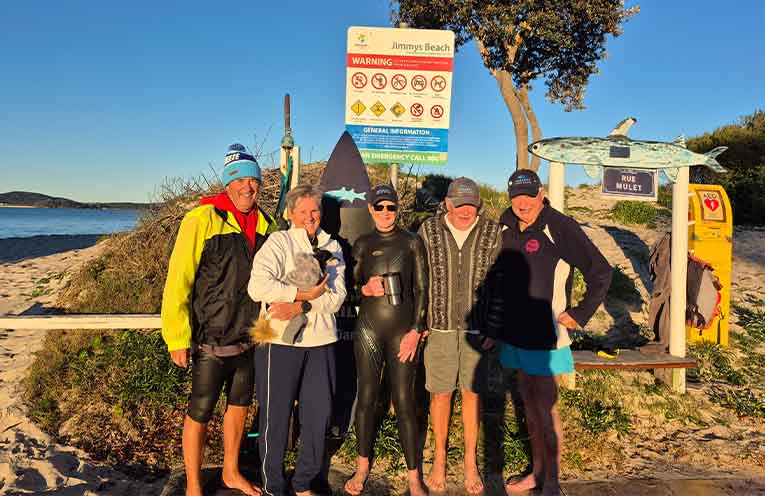
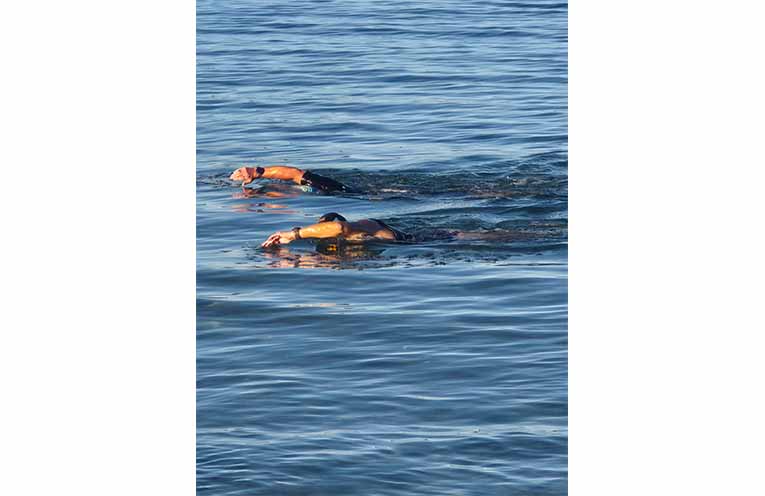
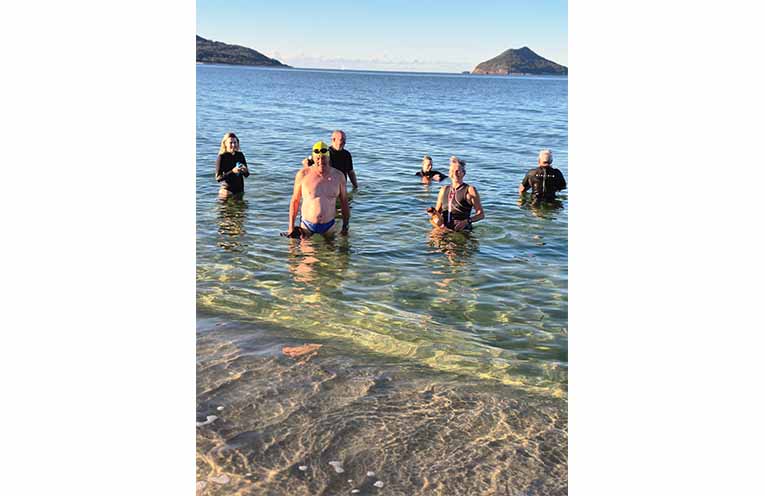
TWO local swimming groups took to the water on the brisk, early winter morning on a special day – the Winter Solstice, 21 June 2026.
Echoing traditions handed down over millennia, they celebrated the astral milestone like any sane person would – by taking an extended swim through freezing waters in the middle of winter.

“Winter Solstice? Just another swimming day for the Hawks Nest Mullets and Mackerels!” swimmer Chris Lock told NOTA.
“At 7.30 am sharp, our fearless band gathered at Jimmys Beach for the daily ritual – a compulsory 500m or 1km swim in the crystal-clear waters of Port Stephens.
“At a brisk 17°C, it was ‘almost’ warm enough to leave the wetsuit at home.
“With men and women of all ages, including our oldest youngster at 84, we proved that the best way to celebrate the shortest day of the year is with the longest smile.
“What a wonderful tonic to start the day!”
The official temperature recorded for 21 June along Jimmys Beach was 19.6 degrees Celsius, but the swimmers no doubt would argue that it was much, much icier, especially with windchill upon exiting.
Thankfully, for all concerned at the Mullets’ and Mackerels’ swims along the northern shores of Port Stephens, unlike their counterparts in the Dark Mofo Nude Solstice Swim in Hobart, they did not feel compelled to strip bare for their otherwise usual morning swim.
The southern winter solstice was officially Sunday, 21 June, and marked the ‘shortest’ day of the year; the day with the shortest amount of sunlight in the southern winter.
It is, of course, the summer solstice in the northern hemisphere.
Most likely because they are relatively easy to measure, and because, with the right technology and keen observation, solstices are highly predictable, they have formed the foundation of several major cultural events around the world, including: Dongzhi Festival (east Asia), Shab-e Yalda (Iran), Inti Raymi (Peru), Toji (Japan), and Grianstad an Gheimhridh (Ireland).
Most of these occur in the northern hemisphere, hence in December, and are often overshadowed in Western countries by Christmas and New Year’s Day.
More locally, the winter migration of whales heading north along Australia’s east coast appears to align with the winter solstice, underlining the impact that such astronomical recurrences can have, not just to human cultural organisation, but to the equilibrium of ecosystems of the Earth itself.
For those who watch the calendars, the winter solstice is literally the dark heart of winter, which means that now we are on the other side of it, recent weather notwithstanding, and surely headed back towards summer. Each day the sunrise and sunset creep further away from each other.
In NSW, on the first weekend of October, we claw back an entire hour of daylight, making summer sunsets wait until 8pm, or even later further south.
Many currently long for darkness to descend later than 4pm, and those driving long roads home will be more thankful for longer afternoons, too.
The Mullets swim at The Anchorage at the intersection with The Boulevard whilst The Mackerels swim adjacent to Barnes Rock, Winda Woppa.
By Thomas O’KEEFE