
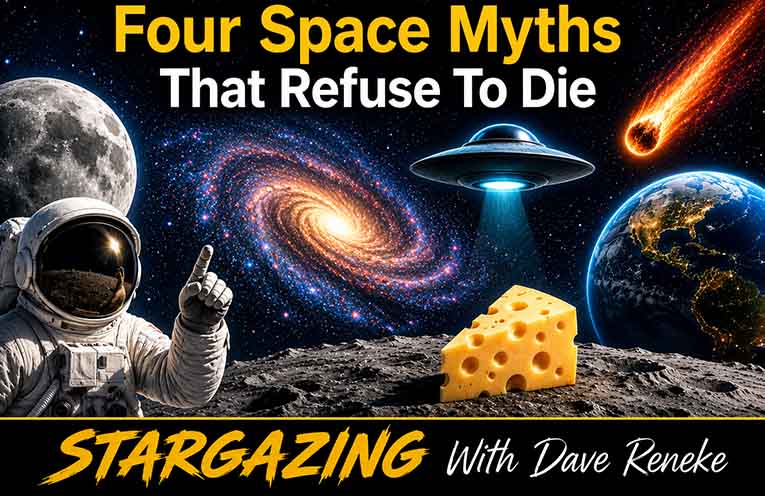
SPACE has always been fertile ground for myths, perhaps because the night sky is so enormous, mysterious and difficult to visit that humans have filled the gaps in our knowledge with stories, guesses and the occasional piece of complete nonsense.
Some are harmless fun, while others are so persistent that they deserve a gentle blast of scientific reality.
Take the wonderfully ridiculous idea that the Moon is made of cheese.
Sorry, Wallace and Gromit, but the evidence is firmly against you because the Moon is a rocky world covered in dust, mountains, valleys and countless impact craters.
Its surface has been battered by asteroids and meteoroids for billions of years, while ancient volcanic activity produced the enormous dark plains we call maria.
The Moon isn’t particularly shiny either, reflecting only about 12 per cent of the sunlight that falls upon it, making it about as reflective as worn asphalt.
That beautiful glowing Moon, therefore, isn’t a gigantic piece of Camembert beaming back at us; its minerals are simply reflecting sunlight.
Then there are shooting stars, another case of misleading terminology because there is no star falling out of the heavens, desperately trying to find somewhere to land.
A shooting star is usually a tiny piece of space debris, often no larger than a grain of sand, entering Earth’s atmosphere at enormous speed, where friction and compression heat the surrounding gas and create the spectacular streak of light we see.
The object itself is called a meteoroid while it is in space and a meteor when it produces that brilliant streak, while any surviving piece that reaches the ground becomes a meteorite.
So, when you see a shooting star, make a wish, but don’t ask it to slow down because some meteors can enter the atmosphere at more than 70 kilometres per second, making that one very fast wish-delivery service.
Now for one of the most famous myths of all: the Great Wall of China can be seen from space.
It sounds plausible and has been repeated for decades, but it isn’t true in the way people imagine.
Astronauts in low Earth orbit can sometimes photograph portions of the wall under favourable conditions, but it is extremely difficult to distinguish with the naked eye because the wall is simply too narrow and blends into the surrounding landscape.
From the Moon, forget it because the wall is far too narrow, and its winding shape doesn’t magically turn it into a giant planetary sign saying “Welcome to China.”
I remember astronaut Buzz Aldrin telling me that they couldn’t see it from the Moon, and at roughly 384,400 kilometres away, even an enormous telescope would have trouble picking out such a relatively thin structure against the Earth’s complicated landscape.
And finally, we arrive at the flat-Earth myth, at which point perhaps it really is time for a Panadol.
Earth is demonstrably spherical, and we have mountains of evidence — literally and scientifically — including ships disappearing hull-first over the horizon,
There is also the small matter of time zones because when it is lunchtime in Australia, people elsewhere can be asleep in darkness, and on a flat Earth illuminated by the Sun in the ordinary way, explaining that would require some remarkably creative geometry.
The universe is full of genuine mysteries, but we don’t need invented ones because the real story is far more fascinating: a rocky Moon, fiery meteors, a magnificent but difficult-to-see wall, and a spherical Earth hurtling through space.
And thankfully, none of them is made of cheese.
See Dave’s website www.davidreneke.com
By Dave RENEKE