
MEMBERS and guests of the Hawks Nest & District Probus Club were treated to a rare peek behind the iron curtain, with a speech from local and member Colin Gratwick on Friday 7 August.
Colin’s trip to Mongolia, back in 1991, was at a turbulent time in the region, sandwiched between the collapsing USSR and People’s Republic of China, while regime change swept through Europe and Asia.
Colin’s journey, one of many he had undertaken in his professional career as a dam engineer, including all around Asia and Africa, was to consult for a dam project in rural Mongolia, which had only just come out of decades of communism itself.
“I arrived in Mongolia in January 1991, right in the middle of the local winter, and troubles began almost instantly,” Colin recounted.
“A recent ‘peaceful coup’ – the ‘Democratic Revolution’ in late 1990 – meant the ‘visa-on-arrival’ that I was expecting to be granted was no longer an option, and so I was escorted by an armed soldier into a room and locked there for a while.”
Before too long, the paperwork was sorted out, and Colin was set free after paying only double what he was expecting to be charged for his visa.
“When I finally boarded the bus with the other international consultants, I was applauded, and learnt that they had all done it ‘by the book’ before leaving … in most cases, that meant taking an extended international trip to the nearest Mongolian Embassy on their continent (Europe, North America), making my own ordeal perhaps the cheapest and fastest option, as it turned out.
“The temperature outside was minus 22 Celsius when we landed, at an altitude of 1350m above sea level, but the heaters were set at +35 degrees inside the hotel.”
Colin and the other international consultants were flown in a beastly MIL-8 military helicopter that shuddered and billowed black smoke as it took off, out to the proposed dam site, with standing room only inside, unless they wished to sit atop the internal fuel tanks.
Along the way, they visited a small yurt occupied by a rural Mongolian family of nine, but found it cosy inside and enjoyed local fare, including dumplings and fermented mare’s milk – the nearest supermarket being hundreds of miles away.
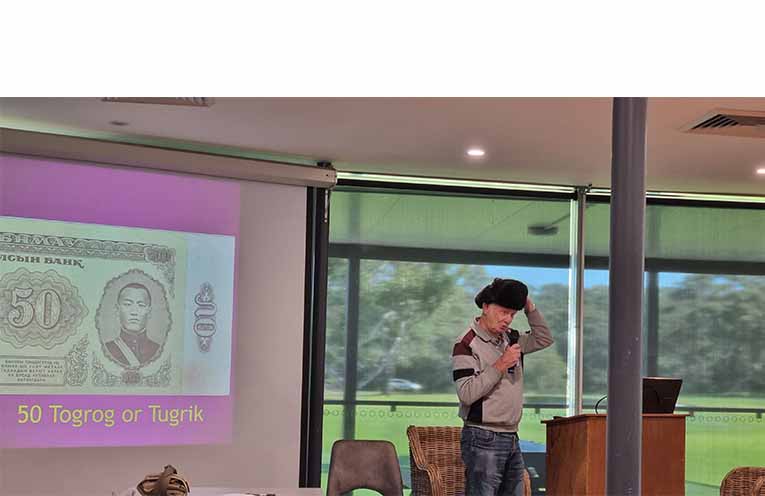
Back in the city, another surprise was that local currency exchanges were performed based on real-time wall-mounted counters, each ticking over the ever-fluctuating currency comparisons, and needing to be chosen exactly to the second to exchange – in 1991, 50 of the local Tugrik were worth about AU$3.80.
A must-buy souvenir was the Mongolian hat, which Colin modelled and confirmed it warm enough to beat even the most savage cold.
The trip’s farewell dinner was a ‘mystery stew’, with very few English speakers around, and Colin and the others also witnessed the legacy of communist food lines, in the massive lines of people waiting at food stalls, to get their black potatoes and questionable ‘meat’.
At the airport, passengers crowded the tarmac at the base of the plane, many smoking heavily despite the pungent tang of aviation fuel in the frigid air.
“On board, we were told to ‘sit anywhere’ when we asked where our assigned seats were, and several luggage compartments remained open, with many passengers still standing as the plane taxied and took off,” Colin recalled vividly and with a strong hint of concern.
In-flight refreshments were vodka, and more vodka, with many aboard surprised that the plane made it home at all.
By Thomas O’KEEFE