
Share via:
Part 2 – The crab kings
IT’S hard to believe, considering today’s value, that crabs were once a big problem. There were heaps of crabs but no known market, and they really were a pest.
They would tangle and rip the mesh nets, chew on the fish you caught, and snap on to your finger if you got close enough.
Any crab that was caught up in the fishermen’s nets was stomped, smashed with a “donger” or crushed to remove it from the net. Hundreds and hundreds of them.
It was only when a fisherman named Chapman came down from Forster and set traps in Port Stephens did Keith “Westy” Davis start to think that there must be some money in the things somewhere.
“That bloke is not coming down here for nothing – if he is bringing traps all the way from Forster there has got to be money in those things,” he reportedly said. “I’m gonna put some traps out!”
In 1969 he made his first traps out of oyster sticks and skinned them with 2×2 wire before dropping them out the back of Oakey Island, west of Soldiers Point.
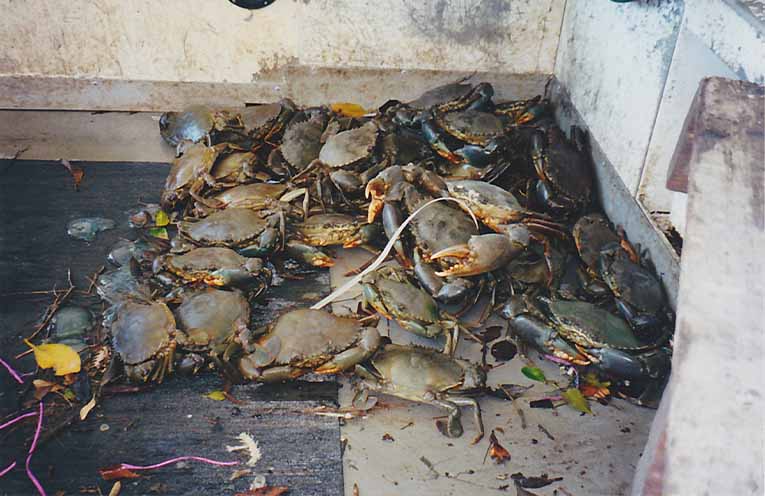
The traps immediately filled with blue swimmer crabs and the wheel began to roll.
As Westy was working on his own, his first reaction was to keep everything as quiet as possible and not tell a soul. The crabs were caught and placed in a cool room used for bait at the back of the property.
“We’ve got to keep this quiet,” he told his wife Sue. “There’s a quid to be made here.”
The crabs would be cooked then snuck away down to the Sydney market.
Westy and Sue would travel to Sydney and stay in a motel, the Windsor Gardens, overnight before driving the crabs into the fish markets at 4 o’clock in the morning and unloading the catch.
There were very few other crabs on the floor of the markets, apart from those sent down from the Queenslanders who, by law, were not permitted to sell female crabs.
Asian people preferred the sweetness of the meat of female crabs and this was only available through NSW suppliers who were permitted to market the females.
Westy was on a winner.
Back when Westy’s enterprise was starting to get a roll along, the crabs were cooked in the back yard out at Soldiers Point.
The cookers only had a little short blower, about 5-6 inches long, and when it was lit it roared like a jet taking off – not good when everything was being done as quietly as possible.
Everyone in Soldiers Point knew when the crabs were being cooked and gathered to the sound to buy fresh crabs from the Crab Man.
It may have been Jimmy Chalkley who finally worked out that the way to silence the cooker was to “travel” the flame – make it go over a longer distance. The blower was extended to about 30 inches and the resulting silence was immediate, allowing the process of cooking the crabs to become sneakier.
Westy kept the secret for quite some time – about six or seven years – before other fishermen started to wonder what was going on.
What was under Westy’s floats? The game was up.
By this time the Crab Man had worked out that he could catch crabs all year round with the black crabs (muddies) coming on later in the summer months. The NSW Fisheries law restricted the number of traps to 10.
This law was simply senseless for any professional trying to make a living. As a result it was a constant challenge to keep his activities as discreet as possible.
On a good day with his ‘10 traps’ Westy could return with five boxes of blue swimmers.
‘Pungering’ in Tilligerry, wife Sue recalls tying up nine boxes of black crabs, somewhere between 150 and 180 crabs. One monster weighed 6 ¾ pounds.
That was an extraordinary day; it wasn’t always like that.
At this stage Westy joined with the Chalkleys – Geoff, Jack and Jim – to form a very successful partnership
The womenfolk played a very significant part in the commercial fishing industry. Sue Davis and Janet Asquith were certainly keen to be involved in anything to help the fishermen. Sue has many memories of a great time.
“Keith, Charlie Asquith and young Les Asquith were working together way up in the Karuah River near Allworth. When they caught a heap of fish they would contact me, or Charlie’s wife Janet, and we would both drive up to Allworth, towing trailers, to bring the fish back to the Co-op in Nelson Bay,” she recalled.
“Before the Grahamstown Dam was filled the road was a shocker, full of pot holes, and there were five rickety bridges to cross.
“It was along this road that we travelled, me in a Holden panel van and Janet in a VW Kombi.
“This day, as we bumped along on our way to Allworth, I was following Janet and her trailer, unbeknownst to her, came loose and flew off into the bushes.
“So I’m trying to signal Janet to stop, waving frantically out the window, to no avail. I finally got the message across by driving alongside.
“‘Janet, your trailer has gone!’”
“‘Where?’” yelled Janet.
“‘It’s in the bushes way back.’”
“We turned around and went searching for the trailer, which we had to rope and tow out of heavy scrub.
“We finally got to Allworth, where we had to go across private property to reach the men who loaded up the trailers with fish for us to take back.
“On another occasion I got a loan of Clarrie O’Brien’s old trailer for the Allworth trip. Clarrie was a plumber bloke that lived here.
“Well, by the time I arrived where the men were fishing, the bottom of the trailer was missing. The wooden planks had all bounced out.
“Fortunately at Allworth there was a mill, so they just went up and bought some six-foot palings and put them in the bottom before pouring the fish on top.
“Another time we had to bring the fish back to the Bay in a horse float because there were too many fish for the trailers.
“Think of the person driving behind the float when fish started jumping onto the road,” Sue smiled.
Sue was Westy’s constant work companion in the latter years, shortly before the Crab Man’s health began to fade. “This was a wonderful time that we spent together working the creeks and mangrove swamps,” she said.
“It was my job to tie the crab ‘claws on chest’ ready for market. I’d tie up and Keith would lift the traps. It was great.
“Keith was a funny man. He was very generous and giving; however, if he was upset by anything he certainly let everyone know it.
“Just before Easter he would go out into the port and set his nets so that he had plenty of fish to give away.
“The Thursday nights before Good Friday was a crazy time, working flat out cleaning fish to give away. He would say, “The best price you get for fish is for the ones you give away.”
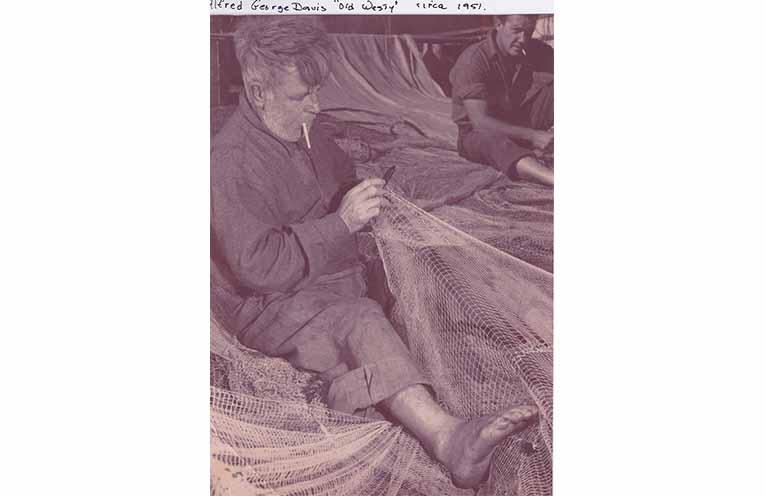
Over the years Westy worked at just about everything – meshing the estuaries, prawning the Myall and the Hunter River, lobstering on Broughton, eeling the lakes and hauling the beaches, where he was referred to by some as The Claw.
Keith Alfred “Westy” Davis, who passed on in May 2002, was recognised as an outstanding fisherman, however he will always be remembered as the Crab Man.
By John ‘Stinker’ CLARKE
You can help your local paper.
Make a small once-off, or (if you can) a regular donation.
We are an independent family owned business and our newspapers are free to collect and our news stories are free online.
Help support us into the future.
Share via: