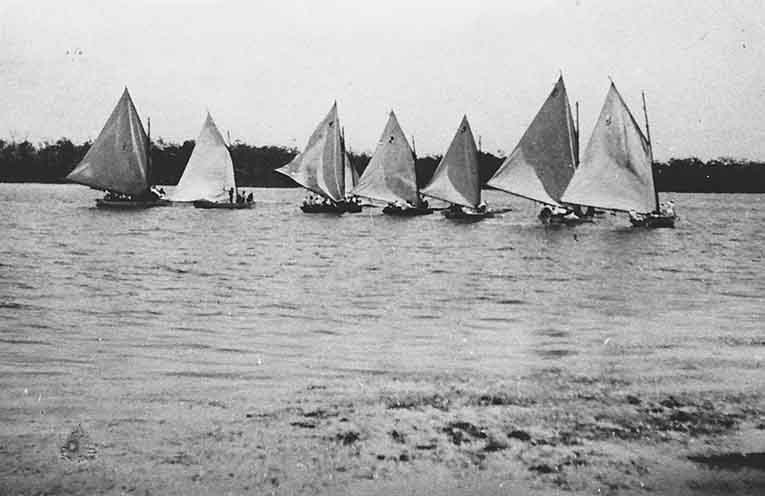
OLD timers may recall the great days of the Annual Mungo Brush Regatta.
Nestled in a protected corner of the Myall Lakes, on the eastern shore of the Broadwater, Mungo Brush was the perfect setting for the regatta conducted by the Port Stephens Regatta Club since 1903.
As documented by Publicity Officer Tim Motum the regatta was reputed to have started as a grudge match between rival hauling teams of fishermen.
They met annually at Mungo to pit their wits and sailing skills against one another for three or four years until it became an organised event.
The regatta developed into a huge social gathering with some families staying on the lake for up to a month.
The closure of the timber mills on the shores of the lakes over Christmas gave the workers a chance to get away and they and their families attended the regatta on droghers, which acted as dance floors and sometimes provided overnight accommodation.
Everyone had to travel by water as no roads were in existence in the area.
A cutting from the Port Stephens Pilot, December 1913 read: “The S.S. Nepean will leave Sawyers Point (now known as Karuah) on Monday 27th Dec at 6.30 am sharp. Leaving Tea Gardens at 8.30am and returning to Tea Gardens and Sawyers Point on Tuesday evening. Return fares to Sawyers Point three shillings and one shilling and sixpence return to Tea Gardens. All visitors must bring camping requisites. Adolph Engle S.S. Nepean.”
Hugh Thurlow’s passenger boats also connected with the horse drawn passenger coaches from Newcastle, collecting people from Salt Ash and ferrying them to Tea Gardens for connection to the “Nepean”.
Other boats included the shallow draft steamer “Myall River” and the “Coweambah” picked up people from Buladelah and Bungwahl for the trip to Mungo Brush.
It was not uncommon to have a crowd of 1000 at the Regatta to enjoy the boat racing, merry-go-rounds and side shows.
People used the regatta as an excuse to dress in their best clothes.
Ladies wore hats and gloves and sometimes carried parasols to ward off some of the midsummer heat, while gentlemen wore suits, or panama hats with sports trousers and blazers; watches and chains were conspicuously displayed.
Racing in the early days was all sail as it was long before the appearance of the internal combustion engine in the area.
The large work boats, used all year for fishing, were rigged with an enormous sail and resembled the early 18 foot sailing boats.
One of the largest boats was sailed by the Motum brothers; the “Comet” was 22 foot long and had a nine foot beam.
Boats from outside the area soon appeared with the Forster boats being sailed to the lower end of Wallis Lake, then transported overland via Smith Lake to Bungwahl by bullock team.
The boats were then re-rigged and sailed down the lake to Mungo.
The Newcastle boats were launched at Salt Ash then towed to Mungo behind one of the many vessels headed that way.
The appearance of the internal combustion engine in the area opened up a whole new scene and once again it was the work boats that took part with all shapes and sizes of vessels vying for the ever increasing prize money.
In the early 1950s class racing began with the introduction of the ever popular Simplex Marine Engine.
Two sizes competed, the five horse power and the powerful 10/12 horse power models for larger boats.
Many owners could be seen stripping out the heavy work fitting, bunks etc to try and grab an extra knot or two.
As car engines became both more powerful and lighter in weight, the era of the speed boat was born and for the first time boats were constructed especially for racing.
This move freed builders and designers from the requirements of the work boat and opened up a whole new era for shapes and construction.
The Lyall Bros. from Carrington – Ken, Bill and Doug – were well known oyster farmers and avid fans of the Mungo Regatta.
They built their own boats, one of which was powered by a V8 Curtis aeroplane engine and was, not surprisingly, the boat to beat for several years.
As the prize money increased so did the interest of boat owners from far and wide with all styles of racing boats, powered and sail, being entered.
The regatta continued after the gazetting of the Myall Lakes National Park in 1972 and was supported by the NPWS and the Maritime Services Board.
Both departments assisted by authorising “sealed roads, car parking and boat launching ramps at the site”.
To the regret of many local residents and visitors, the last Mungo Brush Regatta was held in January 1999.
By John ‘Stinker’ CLARKE