
THE villages of Tea Gardens and Hawks Nest and communities on the north side of Port Stephens were dangerously close to a bushfire that burnt to their north from late January to early March this year.
On 27-29 January, the ‘Nerong Fire’ came close to the villages and the communities’ only exit road from the peninsula. Embers were blown into houses some distance from the fire; the air quality was poor; and a large, dark smoke plume billowed to the north.

For many residents it was the first time in their lives they faced the prospect of evacuating or staying to protect their homes.
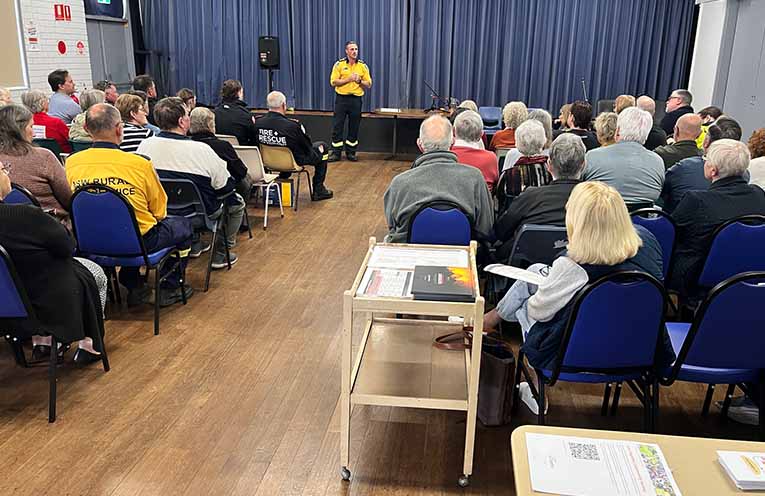
This was a wake-up call for many and led the community organisation Lyne Together to arrange a forum on Saturday, 29 August, at the Hawks Nest Community Hall, to review the lessons learnt from the incident and hear about everybody’s experiences and concerns.
Andrew Dickinson, from Lyne Together, introduced speakers from New South Wales Fire and Rescue and the Rural Fire Services, locally, and from the Fire Control Centre, in Taree. These speakers outlined the complexity of managing the earlier Buladelah Fire and Nerong Fire, which burned on private land including a pine plantation, and on an area of National Park.
In addition to the people and equipment working day and night on the ground, a large number of firefighting aircraft movements were required.
The group also learned that every time the main highway had to be closed, it cost $12 million dollars an hour.
Jeremy Miller, from Lyne Together, then chaired a Q&A session where forum participants shared insights, questions and local solutions.
Obtaining up-to-date information was a concern for many, given the area’s patchy local internet and phone services. Some were surprised to learn that an information service had been set up outside Coles in Tea Gardens during the danger period.
It became clear that the elderly population often depended on ABC radio emergency messaging rather than social media, and few used the Hazards Near Me app.
One unexpected issue was stranded schoolchildren travelling by bus affected by highway closures.
A Red Cross member reminded the group of the availability of that organisation’s emergency kits, which included battery-powered wind up radios.
The group learned that the websites of NSW Fire and Rescue and NSW Rural Fire Services contained lots of useful information, and included ways to make residences more fire safe, and ways to find services to help people with disabilities remove hazards from their dwellings.
During afternoon tea, many stayed behind to get further information and exchange ideas.
All appeared to leave the meeting remembering with gratitude the long and hard work put in by all the emergency services personnel and their volunteers.