
Share via:
THE 1950s was a time of great excitement for Patricia Hickey.
Along with her brother Robert, sisters Barbara and three-year-old Susan, she had moved into the lighthouse keeper’s residence with mother Millie and father Bernie, the newly appointed light keeper.
Back in 2018, I interviewed Patricia for a book I was writing, The Outer Light.
For Patricia, the island was a paradise.
This is her story…
“Going to Point Stephens, on Fingal Island, as a nine-year-old, after spending two years on Solitary Island, was like a dream: beautiful beaches, cows, a big garden, an orchard and so much room to run around.
“The jetty was in a beautiful sheltered cove, and the basket was a walk in the park after the drama of getting on and off Solitary.
“After our horrible experience of the basket getting on and off South Solitary Island mum and Susan were hauled up in the basket while Dad, Robert, Barbara and I used the ladder attached to the front of the jetty.
“We were at Point Stephens in 1955-1957 and probably had two years there.
“It was a two-man station when we were there – the head keeper was Bill Tulk (and Olive) and dad (Bernie Hickey) was keeper.
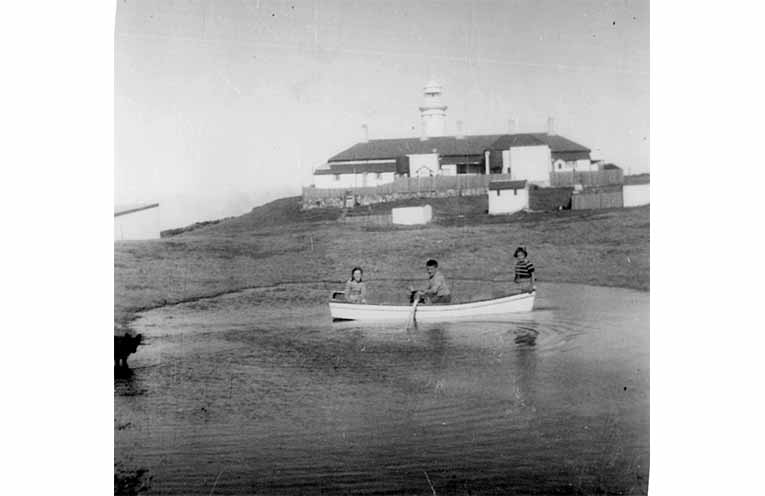
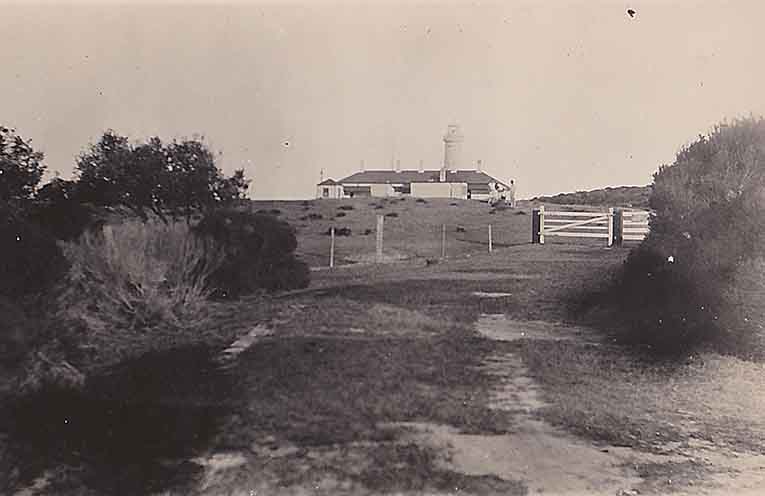
“Our house was on the far right facing the light and Olive and Bill (Wilfred) on the far left with a residence in between, which was used mostly for storage.
“We all worked in the community garden. We loved it and had many picnics there with our billy tea and sausages. “Uncle Bill taught us kids how to be good gardeners (I still love it). He was a wonderful man with so much patience. “He grew asparagus and peanuts for us. We had all sorts of vegetables and always strawberries and melons.
“One of the jobs Robert, Barbara and I had was picking up cow manure for the garden. This mostly ended in tears with cow poo fights. Rob used to throw the wet ones at us.
“The garden was fairly well established when we got to the island. I don’t know how long it had been there but there were mature peach and apricot trees, bananas and citrus trees.
“When we first went to Point Stephens, the toilets were outside of the fenced-in house yards and down a few steps. “The double brick toilet block, which had been for the two keepers, is still standing. I don’t know where the head keeper’s loo was. While we were there, Bill Tulk organised for new toilets to be built by Dad in the house yards at the side of the laundry and near the back fence.
“Our new dunny was timber frame clad in wide weatherboards and the Tulks was brick and is still standing near the remnants of the tank stands in the headkeepers yard – no sign of ours!
“We did correspondence school and the dining room (one of the extensions to the original house and no trace of now) was the school room for Rob, Barb and I and mum was our teacher.
“The fenced area for the lighthouse and for our milking cows was big, probably four or five acres and clear, I suppose the cows kept the grass short right down to the waters edge.
“The dairy farmer, Mr Blanch, owned the cows that grazed 30 or 40. We could pretty much walk anywhere on the island as the cows kept the grass down and made lots of tracks eating or treading down the small scrubby bushes.
“The cows were mustered two or three times a year. It was very exciting for us when three or four young men would come across the spit on horses, come up to the house for a cuppa, give us a ride on their horses and then herd the cows down to the spit and across. They put the baby calves across their saddle,
“I suppose they timed their muster for calving time, sometimes there was quite a bit of water on the spit. I don’t remember if they bought the new lot across the same day or not.
“The sand spit wasn’t very often safe to cross when we were there, mostly only during the extreme Christmas tides. So, it was pretty rare for anyone to come to the island, although I do remember Dad chasing some people out of the garden one time.
“Occasionally the fishermen would come across from Fingal Bay and net off our beach, which was great excitement for us kids. They always gave us fish to take home.
“We spent lots of time at the spit beach swimming and picking up shells, and we used to play in an old timber slab fisherman’s hut that was just off the beach.
“One day us kids had walked up to the top of the mountain we used to call Mount Smokey. We could see several people on the beach, including Dad, so of course we ran down to see what was going on.
“Sadly, a young spear fisherman had drowned coming across the spit. From what I remember three or four young guys were coming across to the island and one got into trouble on the spit. It was pretty treacherous most of the time we were on the island.
“A couple of the gift-type shops used to send us terracotta flower pots, and we used to put shells on them with plaster of Paris and then paint with lacquer and send them back. This was already in place when we got there so we just continued on from whoever was there before us. I still love picking up shells and have quite a collection.
“We used to have regular card nights with Uncle Bill and Auntie Ollie. They would come into our place after dinner. It was always a special occasion, and we would all get dressed in our best clothes. We played gin rummy and us kids were allowed to play too. The highlight for us was the supper – both Ollie and Mum would bake for our card nights.
“From what I remember, our meals on the island were the usual meat and veggies, but we probably had the roast dinner in the first couple of days after the supply boat came. I don’t think our fridge was that great and the freezer was pretty small. Although we always had sausages to cook in a wire rack over the coals of our fire along with our billy tea on gardening days.
“We also had lots of chooks, so plenty of eggs and sometimes fish or, if we were lucky, the occasional lobster, along with whatever vegetables were in season from the big garden. We always had plenty of milk and cream, so mum made lots of custards and rice puddings as well.
“I remember crossing the spit one time carrying suitcases. There was a lot of water rushing across and Bill Tulk was there helping us carry our things and holding on to Barb and I. Dad had Susie on his shoulders and was helping mum and Rob carry gear. Bill went back across the spit, we got changed into our clothes. I don’t know where we were going or why the boat didn’t come for us?
“While we were there, a yacht ran aground near the spit. Someone off it must have come up to the house, probably to use the phone. They invited us to spend the day on the yacht and cooked us lunch. We found out later (long after they were gone) that the skipper was wanted by the police.
“When Dobbin, the old cart horse, was pensioned off, the department gave us an old army Jeep to bring our supplies from the jetty to the houses. The Jeep came to the spit beach by barge. It was great excitement – we were all at the beach for its arrival. I think the weather must have turned because I remember there being quite a bit of swell. Dad waded out to the barge and drove the Jeep off the barge. The water was quite deep when he came off the barge – anyway it all ended well.
“Putting this in writing, it seems there was quite a bit of action at the spit beach during our stint at the island.
“Towards the end of our time there, Bill and Ollie left and were replaced by Alf and Mrs Oslington, whom we already knew from Norah Head and Solitary Island.
”But, nothing was quite the same after Uncle Bill left…”
By John ‘Stinker’ CLARKE
You can help your local paper.
Make a small once-off, or (if you can) a regular donation.
We are an independent family owned business and our newspapers are free to collect and our news stories are free online.
Help support us into the future.
Share via: