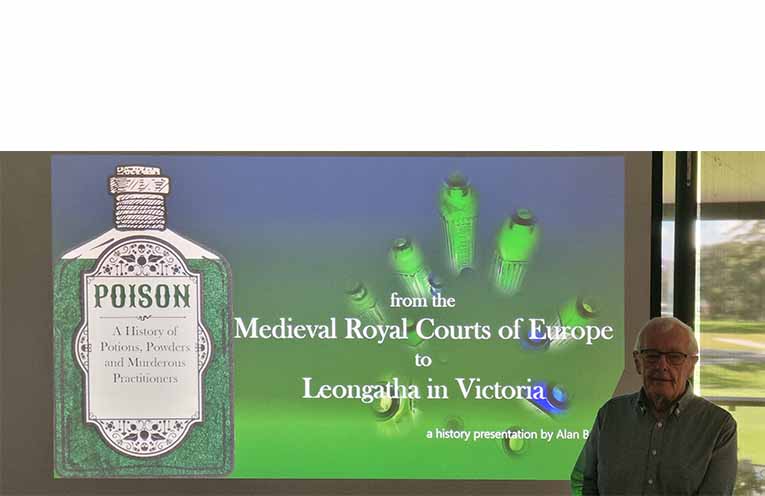
POISON was on the menu at the Hawks Nest & District Probus Club’s July meeting, with a special presentation by local Alan Barr, on the topic of ‘Poison – A History of Potions, Powders and Murderous Practitioners from the Medieval royal courts of Europe to Leongatha, Victoria’.
The 82 members and one visitor heard from Alan, whose historical interests stem from England’s Tudor period, where many of the stories and folklore around witchcraft and poisons collided and ran into the modern day.
There appeared to be many frantic scribblings and pricked ears around the room as Alan elaborated on the definition of a poison, pointing to Swiss alchemist (and father of modern toxicology) Paracelsus, who first declared that ‘all substances can be poisonous… the only difference between a poison and medicine being the dosage’.
“The ‘lethal dose’ concept was coined by Dr JW Trevan, who determined that, for most people, six litres of water, or 118 coffees (175 espresso shots), or 12 shots of 40 per cent ABV alcohol are all likely lethal,” Alan explained.
Unlawful examples of poisonings spanned several high-profile murders in the 20th century, genocide during WWII, and famous cases of suicide, while ‘lawful’ ones included the modern concept of ‘voluntary assisted dying’, which the NSW Government has been one of the last to implement in Australia.
“Poisons have many sources, encompassing plants, animals, elements, and synthetics, with many losing their efficacy once cooked, although some, like the amatoxin found in death cap mushrooms, do not, remaining quite powerful,” Alan said.
Plants named included hemlock, death caps and belladonna, and animals included box jellyfish, funnel web spiders and snakes. Two thirds of the given examples are endemic to Australia.
“The most venomous animal on Earth is the Australian Inland Taipan – 20 times more potent than the king cobra, 400 times the rattlesnake.
“One bite can kill 100 adults, but they are typically shy and docile.
“Their coastal cousins are very fast … they raise up in a ‘S’ shape when ready to strike,” said Alan.
“Australia is home to five of the top 10 most venomous snakes.”
Elements included some well-documented suspects like arsenic, mercury, lead, and thallium, which is banned in Australia due to its historic efficacy.
“Synthetics have included botulinum, a bacterial neurotoxin and the source of Botox, which some people inject into their faces and lips; cyanide, called ‘Zyklon B’ during WWI; polonium; and Novichok nerve agent,” Alan said.
“It is no coincidence that the history of poison runs in tandem with the history of medicine, like Warfarin, which was originally devised as a rat poison, until someone realised that in small doses it worked as an anticoagulant in humans, too.
“Henry VIII closed all the monasteries during his Reformation, and their big herb gardens fell to females to tend, allowing plant-derived poisons to become the female weapon of choice, also enabling the ‘witchcraft’ crossover,” Alan drew on his historical knowledge.
“Henry VIII was paranoid of poisoning, had his food and his bed tested. His son Edward VI shared that paranoia and decreed that poison murderers would be boiled alive, while his daughter, Queen Elizabeth I, was also paranoid, although her lead- and mercury-based makeup likely killed her in the end.
“In the 19th century, arsenic was the ‘miracle product’ of its time, used in many things, including toys, paint, soap – Louisa Collins killed two husbands with it, while strychnine had medicinal uses in aiding paralysed nerves, and were even sold in chocolate-covered tablets.”
“In the 20th century, the Nazis industrialised genocide, aiming to kill 2000 people per hour.”
“In the 21st century, 2006 saw Russian defector Alexander Litvinenko, while in the UK, poisoned by rare polonium in his tea. Doctors say the radiation sickness turned his organs to mush inside him.”
Alan also looked at the suspicious poisonings of Russian double-agent Sergei Skripal, and his daughter, who were exposed to Novichok in 2018, and the case of Russian opposition leader and human rights activist Alexei Navalny, who was killed by an allegedly synthetic version of a South American dart frog poison while in a penal colony in Siberia.
“Poisons were historically the most common weapon used by females, although superseded by firearms lately,” Alan said.
He highlighted the 2024 case of Erin Patterson, which made world headlines, from Leongatha, Victoria, when she located and processed death cap mushrooms (which are surprisingly abundant in certain parts of the country) into a Beef Wellington meal and killed three people, putting a fourth in hospital.
“Apparently there are two appeals currently in the courts, one to get her off, the other claiming her sentence was too lenient,” Alan said.
By Thomas O’KEEFE