
Share via:
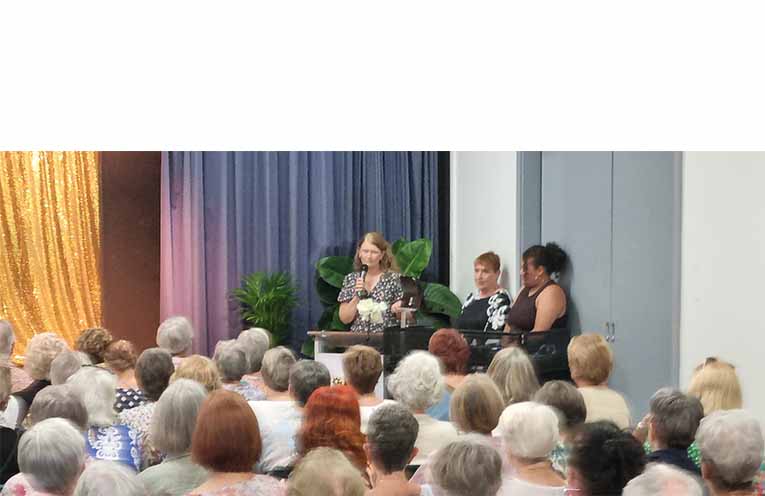
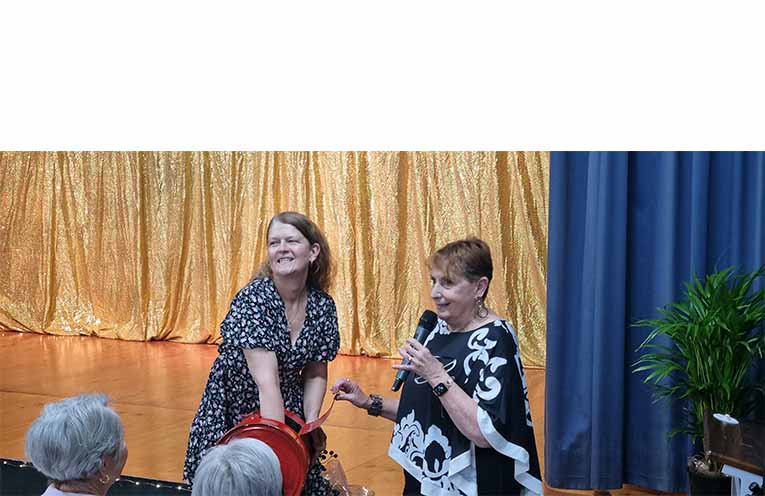
SPECIAL guest speaker Ann Fletcher, assistant manager at Port Stephens Family and Neighbourhood Services (PSFNS), delivered a sobering speech about the modern realities of domestic violence at the Tea Gardens Lions Op Shop Fashion Show on Sunday, 1 November.
The ‘Fashion On A Budget’ show’s primary beneficiary of proceeds from tickets and sales was PSFNS, which has set up four new refuges in the region for women and children fleeing domestic violence.
Fletcher holds a degree in Applied Social Science and brings 25 years’ experience in social work to her role. Throughout her career, she has worked closely with individuals, families and communities, facing a wide range of social challenges, and developing extensive knowledge of the factors that affect people’s wellbeing and safety.
“It is very easy to imagine that domestic violence is a problem that ‘someone else’ would suffer from,” she said.
“But it can happen in all backgrounds and all types of families – even those that appear to be ‘respectable’ from outside.
“There are many different types of abuse, most of which centre on the exertion of power or coercive control over the victim, including financial and emotional abuse. It’s not just black eyes and bruises.
“Stalking, technological monitoring, threats, patterns of behaviour designed to dominate or control aspects of another’s life – it’s about power, control, and fear.”
With the clearer, broader delineation, the statistics are even more alarming: one in four women and one in 14 men are likely to experience DV from the age of 15.
“We need to let go of the idea that DV ‘happens to other people’,” Fletcher said.
“We need to recognise what these abusive behaviours really are. Like when a partner says things like ‘I have the passwords’, ‘no-one will believe you’, or ‘what happens in the home is private’.
“Not that long ago, the behaviours so described were barely even recognised, and even the most egregious forms of abuse were overlooked by governments and laws.”
Fletcher stressed that the way things are now did not just ‘happen’.
“Many things have been made to happen by the hard work of women who have seen how things are and decided that something better needed to be done – none of it was inevitable.”
Examples given included the Elsie Women’s Refuge – opened in Glebe in 1974 after some women’s liberation activists broke into two adjoining terraces rendered empty by the ‘Green Bans’ industrial action at the time, and set up historic women’s refuges.
The annual ‘16 days of Activism Against Gender-Based Violence’ runs from 25 November to 10 December, beginning with the International Day for the Elimination of Violence against Women and ending with International Human Rights Day.
It began as the backlash against the brutal murders of the feminist activist Mirabal Sisters, Patria, Minerva and Maria Teresa, by the Trujillo dictatorship of the Dominican Republic on 25 November, 1960.
“Violence against women is a Human Rights issue, as are concepts like the ‘Reclaim the Night’ rallies, ongoing since 1978,” Fletcher added.
“Women should not have to become experts at avoiding harm, just so those perpetrating it can continue doing it. But that culture still puts the onus to avoid harm entirely upon the potential victim.”
The children’s plight during domestic violence was not to be overlooked.
“Imagine hearing the shouting, the smashing, the threats coming from the other room, then waking up the next morning, going to school and pretending nothing happened,” Fletcher said.
“Home is supposed to be the place where a child is safe, loved, relaxed and calm, but this can undermine their fundamental sense of safety.”
There is also support for men who face domestic violence, and their challenge is to firstly recognise there is a problem, then to ask for help, and then to accept that help.
“We can all ‘notice’ certain behaviours – someone being withdrawn, not smiling or talking as much, and we even notice the perpetrators: laughing at a sexist joke at a gathering, making cruel comments about a partner.”
“The person experiencing DV needs to retain as much control as possible.
“The responsibility belongs to all of us, safer communities are built by all of us.”
Fletcher spoke plainly to her rapt audience about the way DV misconceptions have come about, and how cultural change and the entire community working together are needed to build a better society.
By Thomas O’KEEFE
You can help your local paper.
Make a small once-off, or (if you can) a regular donation.
We are an independent family owned business and our newspapers are free to collect and our news stories are free online.
Help support us into the future.
Share via: