
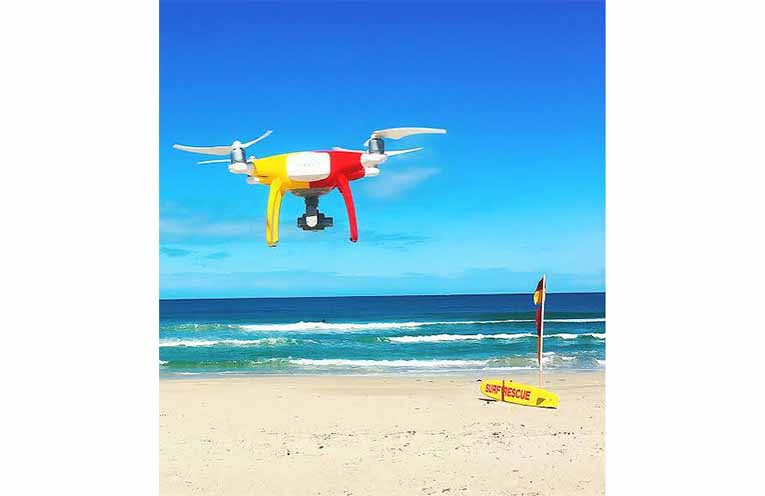
BEACHGOERS will begin seeing even more shark-spotting drones protecting Mid North Coast beaches from this week as the State Government expands its patrol program.
Drones will operate from 6.15am till 5pm every day at nine beaches in the region from September 1 to 30 April next year.

At eight other locations they will fly only on weekends, as well as every day of the Spring school holidays (Monday, 28 September to Friday, 9 October), and then every day from 1 December to 30 April.
Drones will operate each day at Crowdy Head and at Forster-Tuncurry’s Breakwall Beach from 1 September 1 to 30 April next year.
At Black Head, Cape Hawke and Tea Gardens-Hawks Nest, drones will fly only at weekends, each day during the Spring school holidays (Monday, 28 September to Friday, 9 October) and every day from 1 December to 30 April.
The increased coverage is part of an extended drone program to protect swimmers by monitoring sharks along the entire NSW coastline. State-wide, the program includes:
- Extended surveillance hours from 6.15am to 5.00pm as daylight increases during Spring and into Summer.
- Expanded drone surveillance over the NSW school holidays.
- A record 73 drones operating across 97 beaches.
- More than 300,000 scheduled surveillance hours – a 1200 per cent increase.
In addition, 305 SMART drumlines have been deployed from Tweed Heads to Bega, with 51 shark nets laid between Newcastle and Wollongong.
The measures represent a $120 million investment in shark detection measures, according to Minister for Agriculture and Regional NSW, Tara Moriarty.
“I acknowledge there are some mixed views on shark nets,” she said
“But we will use all tools available to enhance the safety of people swimming at our beaches, and that includes nets rolling out on 1 September.
“We are investing in research to understand sharks better and use it to enhance our program to make our beaches safer for swimmers, surfers and families.
“While the risk of a shark interaction can never be eliminated entirely, everyone can take simple steps to reduce their risk, including checking local conditions and downloading the SharkSmart app.
Shark-mounted cameras are helping scientists better understand how sharks use different habitats along the State’s coastline.
Listening stations have been introduced in Sydney Harbour to improve understanding of bull shark movements and provide real-time notifications to the SharkSmart app when tagged sharks are detected nearby.