
MISERABLE grey skies in the morning, followed by daytime gloom, have joined the biting odour of smoke across the Myall Coast and regions nearby in the aftermath of the Nerong fires, lingering in place thanks to a natural meteorological pattern called the “inversion layer”.
While ordinary atmospheric conditions usually see cooler air temperatures at higher altitudes, almost every evening that normality is inverted when the sun vanishes, and the upper atmosphere cools more slowly than the ground beneath.

According to the Bureau of Meteorology’s description of such atmospheric dynamics, when the ground cools at night it lowers the temperature of the lowest level of atmosphere with it.
Warmer air above is free to move, and the upper and lower layers tend to physically separate.
When the air is relatively cool, that means still and steady air at night, but when the atmosphere is loaded with heavy smoke, that smoke gets trapped with the cooler air below, dragging it down to the ground and sea-level along the coast.
“When an inversion is strong, with light and variable winds at ground level, smoke is trapped close to the ground, the inversion acts as a lid, letting the smoke build up, causing problems with air quality and visibility,” the Weather Bureau explains.
Recent mornings have been blanketed by heavy smoke clouds that tend to lift, slightly, throughout the day as what little sunlight gets through warms the ground.
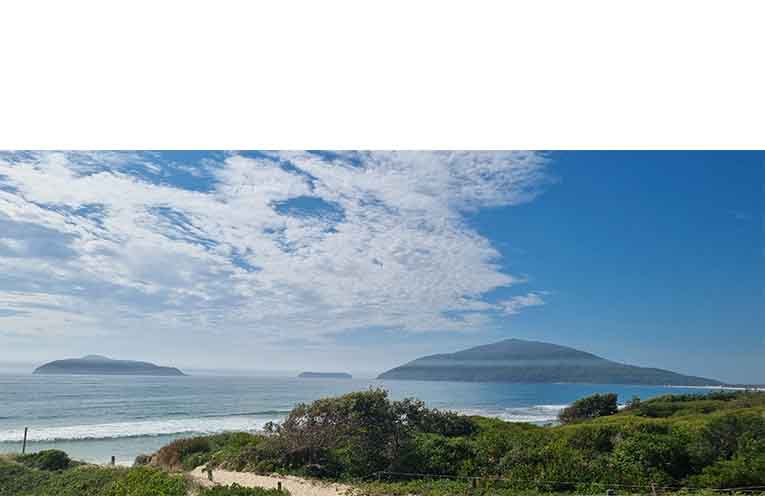
The headlands and islands off Bennetts Beach offer a good background to contrast these lower smoke layers.
Terrain is also a significant factor, with the heads of Port Stephens and Yaccaba acting like walls for the cooler low levels of atmosphere.
Indeed, all down the coast as far as Sydney, headlands have been trapping smoke that has drifted down on persistent nor-easter winds, with nights in Newcastle recently plagued by the Nerong fire pollution.
It is the ‘inversion layer’ concept that actually makes evacuating to bodies of water, including the beach, less of a good idea, as the smoke will indeed settle on these lowest areas at sea-level.
People often automatically consider evacuating to water because “water does not burn”, but the smoke and its tendency to linger must not be ignored – a fact that Myall Coast residents have been reminded of daily for the past few weeks.
Almost impenetrable smoke is also seen along highways in the morning because the roadway tends to be the lowest point, especially between trees and mountains heading north.
All motorists should remain aware that smoke visibility issues may shut off the Pacific Highway.
Air quality should also be monitored – such as weighing the benefits of getting out to do some manual labour clearing up fuel versus the likelihood of fainting from prolonged smoke inhalation and no-one finding you until it’s too late.
Little known fact: when the ground eventually heats up throughout the day, the cool low air does too, allowing it to mix with higher atmosphere layers.
This means the wind from above tends to come down to the ground more in the afternoon, making that the most dangerous time of day for bushfires.
By Thomas O’KEEFE