
Share via:
THE MAITLAND GALE 1898 – A Major Event
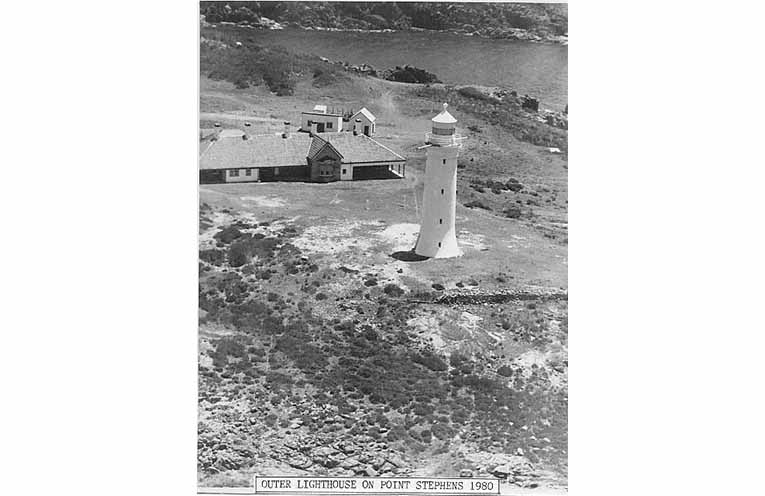
KEEPERS and their families who manned the Port Stephens Outer Light lived a Spartan lifestyle which, for them, became increasingly difficult when in 1891 a mighty sea, referred to as the Maitland Gale, roared from the south and continually battered the finger of land that connected the Outer Light to the mainland.
At the time the “finger”, about 180 meters wide and four metres higher than the top of storm high water, was a well-established, vegetated landform with trees and stabilising rocks.
A track from the mainland to the lighthouse across the natural “bridge” was the main artery for supply and for the lighthouse keepers and their families to occasionally travel by horse and cart into Nelson Bay for supplies and to visit relatives and friends.
By this time the permanent population of the town of Nelson Bay had grown to 30.
When the sea finally settled and the driving winds subsided, the trees and rocks were gone, as was the telegraph line, which was the first and immediate communication with the outside world.
Established in the 1880s the telegraph link, wires and poles – across Narrowgut, to the lighthouse – went overland to Williamtown and Stockton then under the Newcastle Harbour to Wolfe Street and the exchange in Hamilton.
Along with everything else, this vital link was washed away by the fury of the sea.
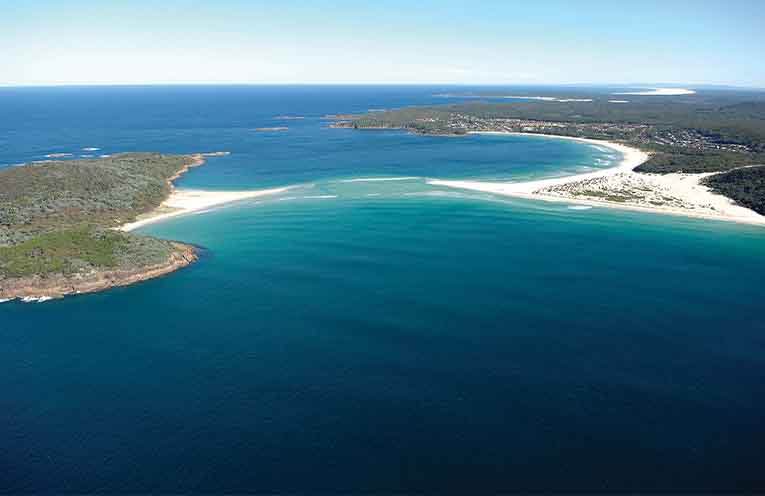
By daylight, where the land track had been, was a sheet of turbulent water 500 metres wide and six metres deep. Gone!
A landform that had taken hundreds of years, maybe longer, to develop, disappeared in a matter of hours.
To the present day there has been no indication that the previously vegetated finger of land that reached out and touched the “island” would ever be likely to return.
Today, with persistent northerly winds and a north swell, the sand builds up over a period to the degree that it is possible to walk across to the “island” from the mainland without getting your feet wet.
During what is known as the “travelling season”, around Easter through to July each year, when huge schools of fish move northwards, commercial fishermen drive their trucks over the Spit and set up camp in the corner of the beach facing northwards towards Broughton Island.
They will make the crossing on many occasions as they transport their fish – mainly mullet, bream and luderick – back into Nelson Bay.
There is, however, no guarantee that the Spit will be there in the morning.
Huge seas from the south build and have the power to wash the Spit away, leaving a raging passage of water far too dangerous to cross, as was the case in 1891.
Unfortunately, some have tried, with the result of 15 lives lost and numerous cases of close encounters.
By John ‘Stinker’ CLARKE
You can help your local paper.
Make a small once-off, or (if you can) a regular donation.
We are an independent family owned business and our newspapers are free to collect and our news stories are free online.
Help support us into the future.
Share via: