
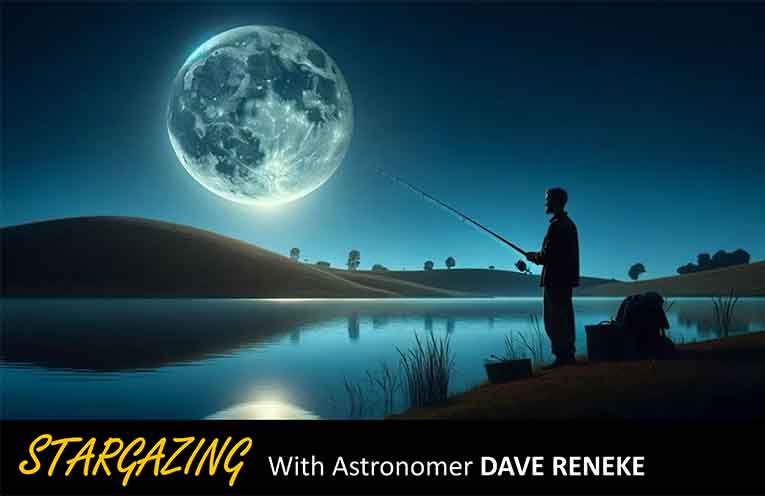
EVERY fisherman dreams of catching the big one – the fish that turns an ordinary day on the water into a season-long bragging right.
But what if I told you there’s a way to plan your fishing trips like a pro, know when the bite will be at its best, and head home feeling like a champion?
Believe it or not, the secret weapon isn’t a fancy lure, a high-tech rod, or some expensive new gadget.
It’s been hanging over your head the whole time. The Moon.
If you’ve ever fished around our region, surrounded by winding rivers, wild scenery, and that quiet magic that only locals truly understand, you’ll know our waterways feel alive.
The fish are there, plenty of them, but they don’t always feel like cooperating.
Some days you could swear the river is full of fish, yet not one of them is in the mood to bite.
That’s where lunar fishing comes in.
Most beginners start out the same way: trying different baits, swapping lures, changing spots, and slowly spending a small fortune chasing “the perfect technique.”
Over time, they get better, but the real question remains: how do you go from catching a few decent fish to landing something that makes people’s jaws drop?
It’s not about throwing more money at the problem. It’s about understanding nature’s timetable.
A group of fishing enthusiasts from our own community decided to test a theory many old-timers have sworn by for years: does the Moon really affect fishing?
Over an 18-month mission, they tracked Moon phases, weather patterns, moonrise and moonset, and matched it all against their catch results.
The verdict?
It works – and it’s far easier than most people think.
We all know fish tend to feed during those classic golden hours, dawn and dusk, but here’s the twist: the Moon can be just as influential, sometimes even more so than the Sun.
The real hidden gold is moonrise and moonset.
These moments, especially when they line up with a new moon or full moon, act like a feeding trigger.
The fish don’t read calendars, but they do respond to the Moon’s pull and the subtle changes it creates in the water.
Here’s the key rule: fish are most active during the 90-minute windows around four daily events: sunrise, sunset, moonrise, and moonset.
That’s 45 minutes before and 45 minutes after each one.
Hit the water during those windows and you’re stacking the odds in your favour.
And if you ever have to choose between sunrise and moonrise?
Go with the Moon. Its influence is stronger than most people realise.
Luckily, you don’t have to stand outside squinting at the sky.
These days there are apps that tell you exact moonrise, moonset, and lunar phase times, so you can plan your trip right down to the minute.
And here’s a bonus: this week brings a full Moon!
When a full Moon rises it can appear 20 percent brighter and 14 percent larger than usual.
It’s spectacular to look at, and perfect for fishing too.
So, the takeaway is simple: Moon phase fishing really works.
Fish smarter, not harder.
Check the Moon, pick your moment, and you might just land the one that turns you into a ‘Local Legend.’
David Reneke is a feature writer for major media outlets and a science correspondent for ABC and commercial radio heard on over 50 stations weekly across Australia.
Get David’s free astronomy newsletter at www.davidreneke.com.
By David RENEKE