
THOSE of us who are concerned with the future health of the waters that flow throughout the Port are continuously confronted by issues that must be identified and hopefully solved – some made by man, some by nature.
There is a growing problem in our midst that I’m sure very few would be aware of.
The problem is the disappearance of sea grasses and sea weeds, which are vital to the long-term health of the system.
Sea grasses are marine flowering plants that form underwater meadows in shallow coastal waters – they have roots, stems and leaves allowing them to anchor and absorb nutrients.
The best local examples being Bagnalls Beach, Jimmys Beach and Shoal Bay.
Sea grasses are vital marine ecosystems providing food, shelter and nursery grounds for marine life as well as stabilising seabeds.
As communities and towns continue to expand along the coastal fringe, sea grasses are increasingly threatened.
Over recent years there has been an alarming decrease in the area under sea grass including Corlette, Salamander Bay, Wanda Beach to Soldiers Point and Taylors Beach. On the north side, Pindimar and Tea Gardens have all but lost their sea grass and weed meadows.
The environmental impact is yet to be realised.
The question is – what factors are causing the demise of the sea grass?
Sea grass is acknowledged by marine scientists as being, along with mangroves, the first link in the environmental chain that results in the sustainability of the aquatic habitat and all those who rely on it.
Development and the associated pollution immediately come to mind along with general water quality, salinity and siltation.
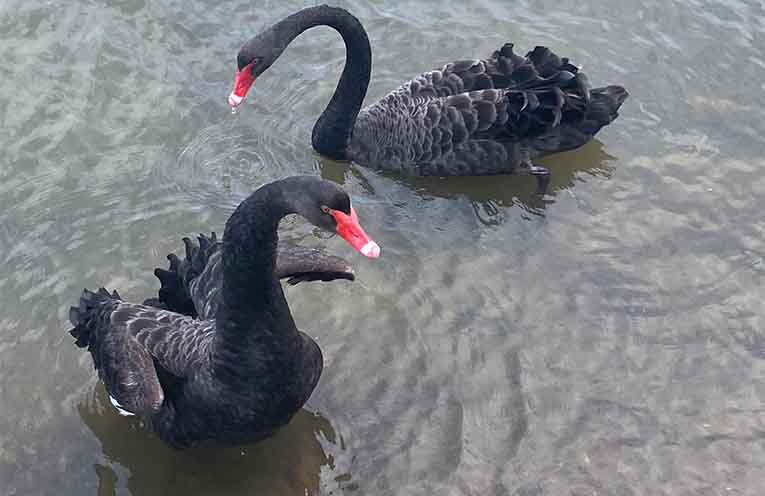
One major contributor, that is continually overlooked, is the destructive contribution of swans!
This is where any efforts to control the loss of sea grass become very confronting.
The Black Swan is an indigenous bird which forms large flocks and are known for their nomadic movements.
They feed on aquatic vegetation, using their long necks to reach underwater grasses which are pulled up by the roots before feasting on the tender shoots.
Flocks of swans, sometimes numbering up to 20 birds, can be witnessed feeding over aquatic meadows throughout the port and into the Myall Lakes.
The destruction to the habitat by the swans was first brought to my attention by the late Geoff Fidden, considered by all who knew him as a guru on all matters pertaining to fishing, habitat and prediction of the future.
Geoff told me that the feasting of swans on sea grass is a major concern and must be controlled if Port Stephens is to remain the fishing wonderland that it has been.
At the time I thought it was an overreaction by Geoff, however over time I have come to understand exactly what he was warning me about.
So! What can be done?
I know that this subject will be discussed by the Marine Park Advisory Committee.
I am keen to learn your response, the reader, to this ticklish issue.
Send me your opinions to stinkerfishing@yahoo.com.
By John ‘Stinker’ CLARKE